
Last Updated: 5 months ago
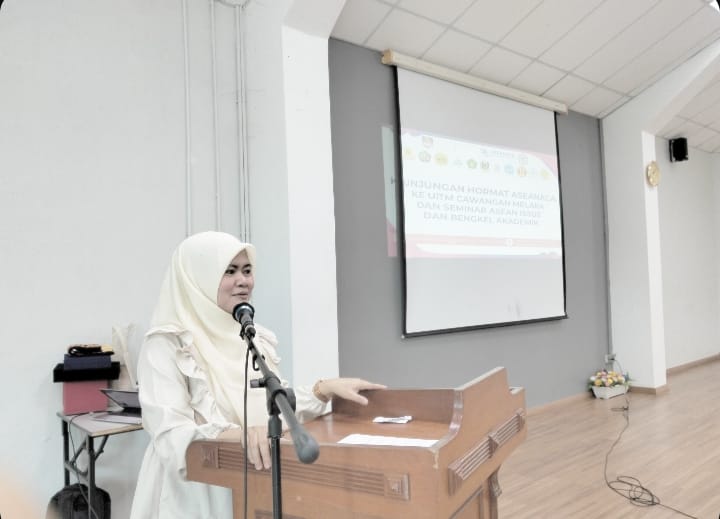
The Elementary School Teacher Education (PGSD) Study Program of Universitas Djuanda once again demonstrated its active role in the international academic arena through the implementation of a visiting lecturer program at Universiti Teknologi MARA (UiTM), Malaysia, on January 28, 2026. This activity was part of a series of international events under the ASEAN Issue Seminar and Academic Workshop, which brought together academics, researchers, and university leaders from various ASEAN countries in a strategic scholarly forum.
During the visiting lecturer session, Dr. Helmia Tasti Adri, M.Pd.Si, a lecturer of the PGSD Study Program at Universitas Djuanda, was invited to deliver an academic presentation entitled “Scientific Reasoning of Elementary Students with Mild Disabilities through UDL-Oriented Gamification.” The topic addressed a relevant and critical issue related to strengthening the scientific reasoning skills of elementary school students with mild disabilities through inclusive, adaptive, and research-based learning approaches.
In her presentation, Dr. Helmia Tasti Adri explained that scientific reasoning is a key competency in 21st-century science education. However, it remains a significant challenge for students with mild special needs, such as slow learners, students with ADHD, and those with mild intellectual disabilities. Therefore, learning approaches that move beyond one-directional instruction are required in order to accommodate diverse learning styles and cognitive needs.
The integration of Universal Design for Learning (UDL) with gamification was presented as a promising pedagogical solution. Through UDL-oriented gamification, learning activities are designed using multiple means of representation, action and expression, and engagement, enabling students to access learning materials according to their abilities. The incorporation of game elements such as challenges, levels, immediate feedback, and interactive visuals was found to enhance learning motivation while supporting the development of scientific thinking skills, including variable control, causal reasoning, and hypothetico-deductive reasoning.
The visiting lecturer session was conducted interactively and involved UiTM lecturers and students in in-depth academic discussions. Participants showed strong enthusiasm, particularly in discussing the implementation of inclusive education at the elementary level, the adaptation of UDL models in the educational contexts of Malaysia and Indonesia, and opportunities for cross-national collaborative research in the fields of science education and special education.
This activity was also part of a broader international forum attended by representatives from 13 universities across ASEAN countries. The participation of multiple higher education institutions strengthened the strategic value of the program, not only as a platform for academic dissemination but also as a means of building sustainable academic and professional networks.
In addition to the visiting lecturer program, the international activities at UiTM included academic seminars, workshops, the signing of inter-university cooperation agreements, and a campus tour. The signing of cooperation agreements marked a concrete step toward strengthening institutional collaboration, while the campus tour provided participants with firsthand insights into UiTM’s facilities, governance, and academic culture as one of Malaysia’s leading universities.
The Dean of the Faculty of Islamic Studies and Teacher Education (FAIPG) of Universitas Djuanda, Dr. Zahra Khusnul Lathifah, stated that the involvement of PGSD lecturers in international visiting lecturer programs is part of the faculty’s strategic efforts to enhance human resource capacity, expand global networks, and strengthen the implementation of the Tri Dharma of Higher Education. She emphasized that the faculty consistently provides full support to all study programs to actively contribute to academic activities at both national and international levels.
Through the implementation of this visiting lecturer program in Malaysia, the PGSD Study Program of Universitas Djuanda is expected to continue developing research-based learning innovations, expanding international collaboration, and making meaningful contributions to the advancement of inclusive education and the development of scientific reasoning skills among elementary school students at regional and global levels. This activity also serves as a strategic step in strengthening Universitas Djuanda’s position as an adaptive, inclusive, and internationally competitive higher education institution.