
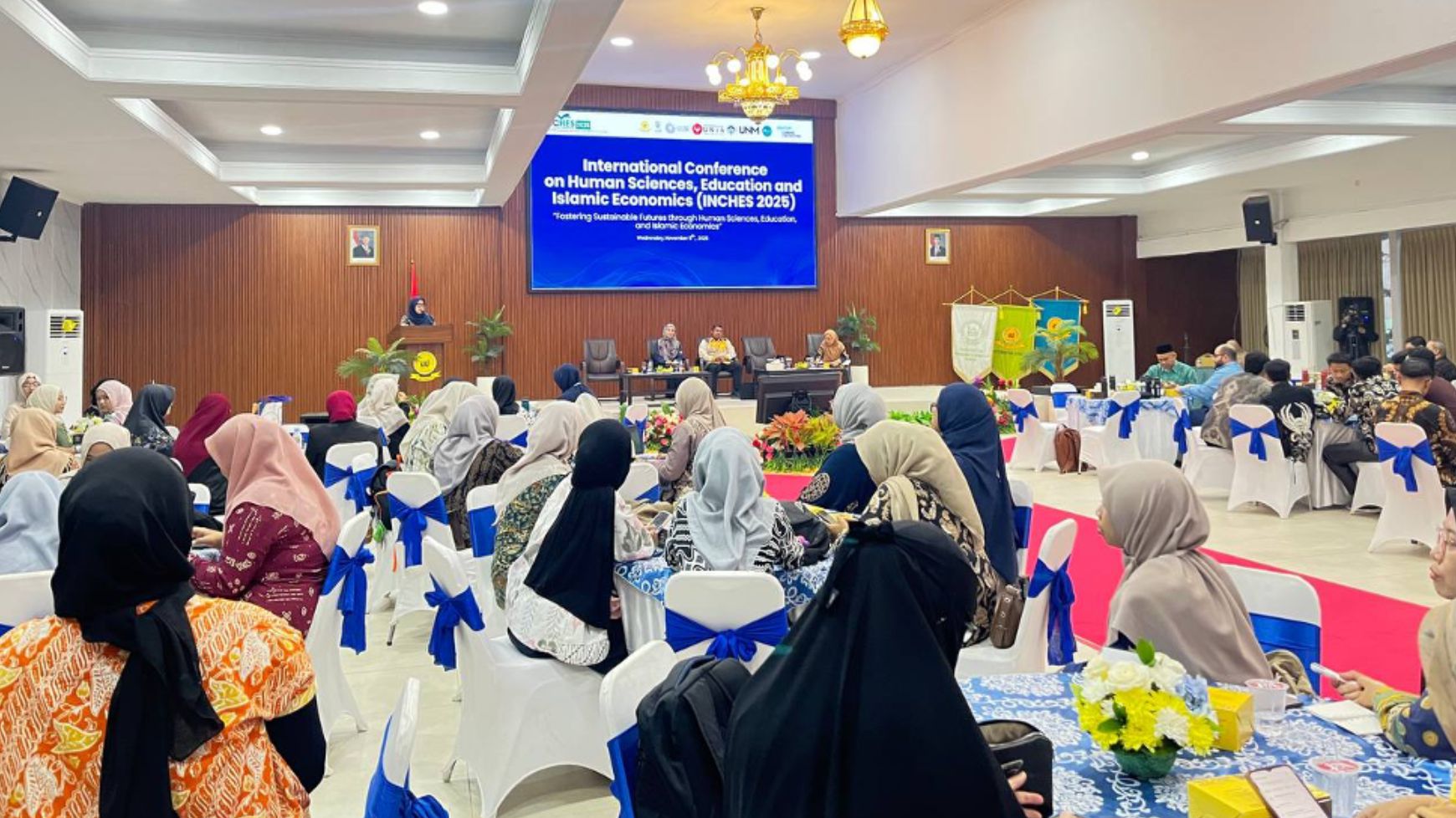
The Faculty of Islamic Studies and Teacher Training (FAIPG) of Universitas Djuanda (UNIDA) hosted the International Conference on Human Sciences, Education and Islamic Economics (INCHES) 2025 on Wednesday, 5 November 2025. The conference was conducted in a hybrid format, held at the Auditorium of Building C, UNIDA Campus, and broadcast via Zoom Cloud Meetings.
Carrying the theme “Fostering Sustainable Futures through Human Sciences, Education, and Islamic Economics,” the conference featured prominent academics and researchers from national and international universities as keynote speakers. These included Assoc. Prof. Dr. Siti Pupu Fauziah, M.Pd.I from Universitas Djuanda; Prof. Dr. Tengku Faekah Tengku Ariffin from Universiti Utara Malaysia; Prof. Dr. Ali Sabri IPEK from Recep Tayyip Erdogan University, Türkiye; Asst. Prof. Dr. Weni Hawariyun from University of Buraimi, Oman; Dr. Amirul Mukminin, M.Sc.Ed., Ph.D from Jambi University; and Prof. Dr. Amirullah Abduh, M.Ed., Ph.D from Makassar State University.
Moderated by Dr. Mega Febriani Sya, M.Pd, a lecturer from FAIPG UNIDA, the event was attended by hundreds of participants from various national and international higher education institutions.
UNIDA Rector Assoc. Prof. Dr. Siti Pupu Fauziah, M.Pd.I, as the keynote speaker, emphasized the importance of synergy among human sciences, education, and Islamic economics as foundations for building a sustainable future.
According to her, education grounded in the principles of tauhid will nurture intelligent, virtuous, and environmentally conscious generations.
“Building a sustainable future is our collective responsibility. Through ethical knowledge, meaningful education, and just Islamic economics, we can create a civilization that brings mercy to all creation,” she stated.
Assoc. Prof. Dr. Siti Pupu Fauziah, M.Pd.I further explained that Islamic education goes beyond a mere knowledge transfer (ta‘līm), as it also shapes personality (tarbiyah) and purifies the soul (ta’dīb).
“Ta‘līm strengthens intellectual capacity, tarbiyah enhances emotional and social intelligence, and ta’dīb cultivates spiritual awareness and self-control — all leading to morally upright individuals,” she added.
Another keynote speaker, Prof. Dr. Tengku Faekah Tengku Ariffin, presented a topic titled “Empowering Teacher Professionalism for Sustainable Educational Futures.” She highlighted the urgency of transforming teacher professionalism as the foundation for sustainable education in the 21st century.
“The global education system is at a crossroads. To achieve a sustainable future, we must strengthen teacher professionalism that is adaptive, collaborative, and impact-oriented,” she said.
She outlined future teacher capabilities which should include future literacy, AI integration, collaborative leadership, emotional resilience, and sustainability awareness.
“The most significant investment in education is not physical infrastructure but teacher professionalism. In their hands, a resilient and sustainable education system can be realized,” she emphasized.
Following this, Prof. Dr. Amirullah Abduh, M.Ed., Ph.D delivered a comprehensive study on language policy development, national identity formation, and bilingual education implementation in Indonesia. His presentation, “Language Policy, Identity, and Bilingual Education in Indonesia,” explored the historical and political trajectory of the Indonesian language policy as well as challenges and opportunities in the era of globalization.
“Language is not merely a tool of communication but a crucial element of social justice. Linguistic discrimination remains an overlooked form of inequality,” he noted, referencing Rosina Lippi-Green’s theory of language as the “last back door to discrimination.”
Meanwhile, Prof. Dr. Amirul Mukminin from Jambi University explained the vital role of Islamic boarding schools (pesantren) as the true embodiment of Islamic education in Indonesia. In his presentation titled “Islamic Boarding Schools (Pesantren) and Human Capital Development: Bridging Tradition and Innovation,” he emphasized that pesantren are not only religious institutions but also centers of character, moral development, and competitive human resources.
He elaborated that based on data from the Ministry of Religious Affairs for 2024/2025, Indonesia has 42,433 active pesantren with approximately 4.9 million students. West Java has the highest number (13,005), followed by East Java (7,347) and Banten (6,776).
“These figures clearly show that pesantren are not marginal institutions but an essential component of the national education system,” he asserted.
Despite notable policy progress, Prof. Amirul noted that implementation remains uneven. Smaller and traditional pesantren often lag in technology, funding, and governance. He therefore called for transformative and collaborative leadership, as well as curriculum enhancement with digital literacy and life skills.
“Pesantren must serve as institutions capable of bridging tradition with innovation — firmly rooted in Islamic values yet open to the dynamics of modern development,” he emphasized.
Joining virtually, Prof. Dr. Ali Sabri IPEK and Dr. Weni Hawariyun underscored the importance of educational reform and Islamic finance as foundations for human development and global sustainability.
Prof. Dr. Ali Sabri IPEK presented “Innovating Primary Education for the 21st Century: Lessons from Turkey’s Educational Reform.” Through the Türkiye Century Education Model (TCEM), the country developed a system focusing on nurturing students who are “competent and virtuous.” This model emphasizes mastery of knowledge, skills, attitudes, and values while ensuring equal learning opportunities for all.
“Student-centered education that integrates values and character is the key to the future of any nation,” he stated.
Meanwhile, Dr. Weni Hawariyuni from the University of Buraimi highlighted the strategic role of Islamic economics and finance in supporting sustainable development in Oman and the Gulf Cooperation Council (GCC).
“Islamic finance is not merely a riba-free financial system; it is a moral instrument that harmonizes economic growth, social justice, and environmental sustainability,” she explained.
In her presentation, “The Role of Islamic Economics and Finance on Human and Sustainable Development in Oman and GCC Countries,” Dr. Weni emphasized that maqasid al-shariah, zakat, and waqf can be integrated with the United Nations Sustainable Development Goals (SDGs).
“Oman Vision 2040 and Saudi Vision 2030 are strong examples of how Islamic values can guide green and inclusive economic policies,” she added.
She also highlighted the importance of collaboration among governments, banks, and universities to advance research and innovation in Islamic economics.
“Education shapes character, while Islamic economics guides behavior — together, they are pillars of a just and sustainable future,” she concluded.