
Last Updated: 2 years ago
The Faculty of Islamic Religion and Teacher Education (FAIPG) of Djuanda University (UNIDA) held a workshop entitled "A New Era in Study Program Curriculum Development: Opportunities and Challenges" on Wednesday (20/9/2023) online through the Zoom Cloud Meetings platform.
The workshop invited a Professor of Curriculum Development from the University of Education Indonesia (UPI) Bandung, Prof. Dr. H. Dinn Wahyudin, MA, and the Secretary General of the Islamic Education Management Study Program Association (PPMPI) Dr. Zainal Arifin, M.S.I as resource persons.
In his speech, UNIDA Rector Prof. Mohamad Ali Fulazzaky, Ph.D. said that the Outcome Base Education (OBE) curriculum depends on the outcome of education applied in higher education. The curriculum is essential to develop, considering that information technology continues to grow and the knowledge-based economic sector continues to increase.
On the same occasion, the Dean of FAIPG UNIDA, Dr. Zahra Khusnul Lathifah, M.Pd.I., M.C.E, said that this agenda is implementing the accelerated higher education curriculum program at FAIPG.
"Alhamdulillah, qadarullah, today Prof. Dr. H. Dinn Wahyudin, MA can be present with us to provide enlightenment regarding the development of the OBE-based study program curriculum which is in line with Merdeka Learning Campus Merdeka (MBKM) and Dr. Zainal Arifin, M.S.I who will specifically convey the OBE-based curriculum, especially in the MPI Study Program," he said.
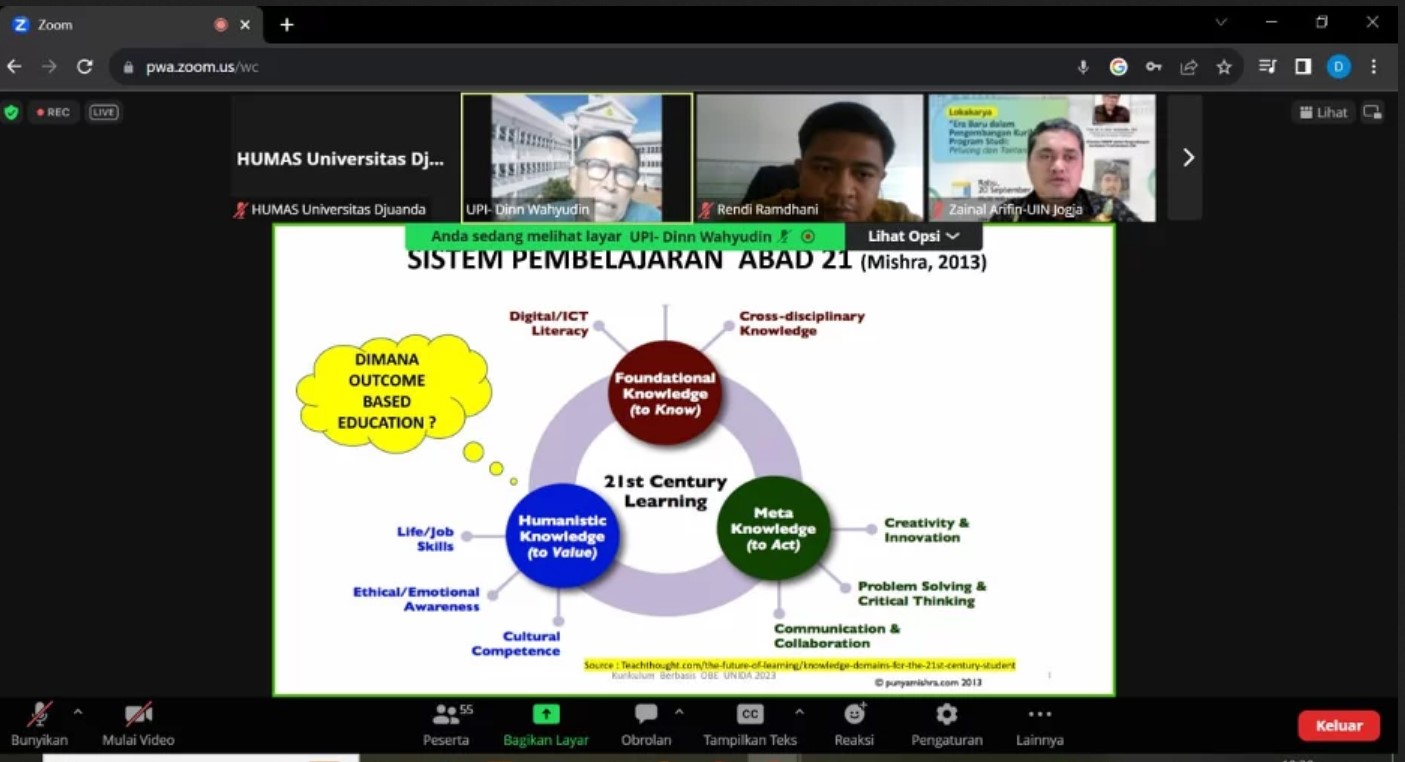
Meanwhile, in the material presentation session, Prof. Dr. H. Dinn Wahyudin, MA, delivered the material with the theme "MBKM in Outcome Based Education (OBE) Based Study Program Curriculum Development."
Prof. Dr. H. Dinn Wahyudin, MA, quoted writing from Alvin Toffler, “The Illiterate of the 21st Century will not be those who cannot read and write but those who cannot learn, unlearn and relearn".
"There are 3 groups referred to by Alvin Toffler. First, are those who are illiterate, those who cannot learn, because they do not have teachers, materials and objects that support learning. Second is unlearn, those who do not want to learn or close themselves to learning. Third is relearn, those who are unable to relearn or close themselves off from learning because they feel enough, or have pride because of their high intellectual or academic level," he explained.
Prof. Dr. H. Dinn Wahyudin, MA, then explained that lecturers are those who learn and teach things known to students as lifelong learners
"MBKM wants students to learn from various sources in order to get the expected competencies in addition to the main competencies as a result of lifelong learning. The emphasis or keyword of MBKM in higher education is OBE," he explained..
In the second material presentation session, Dr. Zainal Arifin, M.S.I, delivered a theme entitled "Preparation of OBE Curriculum Instruments Implemented MBKM."
"The curriculum needs to develop independent lessons, independent forms such as problem listening and project listening. The most important thing about the LAMDIK version of the S1 curriculum is the evidence of regulations at the internal level that will be requested such as the application of MBKM and the vision of the scientific study program also needs to be made a decree," explained the Head of the Islamic Education Management Study Program (MPI) at the State Islamic University (UIN) Sunan Kalijaga Yogyakarta
Furthermore, Dr. Zainal Arifin, M.S.I, explained curriculum policies, support, documents, and other criteria needed to prepare MBKM-implemented OBE curriculum instruments.
"The relationship between OBE and MBKM is that OBE is included in the teaching and learning method and can be used in MBKM, so that students can attend lectures outside the study program and outside the campus. OBE begins with a clear picture of the important abilities that students can do when they graduate," he said.