
Last Updated: 1 day ago
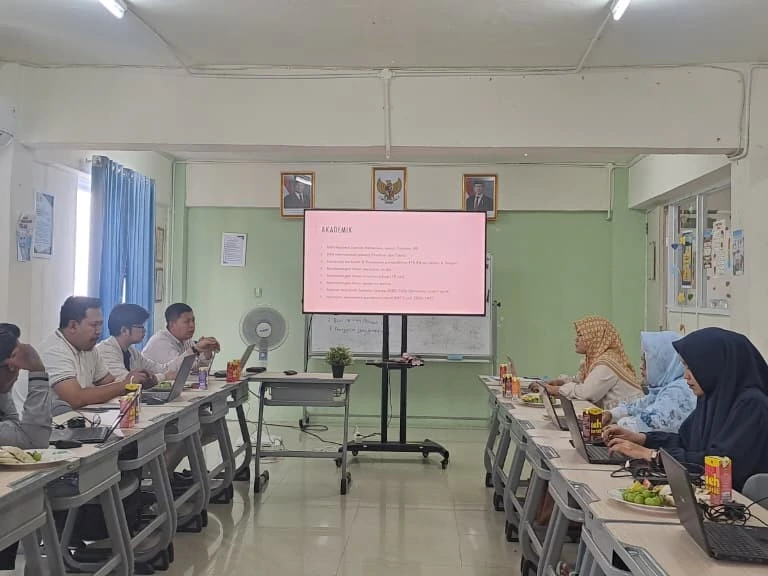
Bogor — The Faculty of Islamic Studies and Teacher Training (FAIPG), Universitas Djuanda, held a structural meeting on Monday, June 15, 2026, in Room G.401. The meeting took place from 13:00 to 15:30 WIB and was chaired directly by the Dean of FAIPG, Dr. Abdul Kholik, M.Pd.I., and attended by faculty leaders, study program heads, laboratory heads, and administrative staff.
The structural meeting served as an internal coordination forum to prepare various academic and non-academic programs ahead of the 2026/2027 academic year. Several strategic agendas were discussed, including Community Service Program (KKN), curriculum workshop preparation, new student admissions (PMB), and improvements in infrastructure and facilities.
In the academic field, FAIPG discussed preparations for the National and International KKN programs in 2026. The International KKN is scheduled to take place from August 17 to September 11, 2026, with a provisional total of 27 participating students. Meanwhile, the National KKN is planned for July 20 to August 20, 2026, and will be conducted in Bogor Regency and Sukabumi Regency.
The Vice Dean for Academic Affairs, Dr. Helmia Tasti Adri, M.Pd.Si., explained that this year’s KKN implementation will also emphasize student academic outputs, such as activity reports, scientific articles, news publications, and Intellectual Property Rights (IPR) outputs for each group.
In addition to the KKN program, the meeting also addressed the acceleration of the 2026 Curriculum Document, which is targeted for completion in July 2026. As a supporting step, FAIPG will hold a Curriculum Workshop on June 23, 2026, at Building C, Universitas Djuanda, involving lecturers, students, alumni, school partners, and resource persons from various universities.
“Each study program has prepared a preliminary curriculum structure and new course designs that will be discussed with the resource persons during the workshop,” said Dr. Helmia.
Other academic discussions included the refinement of the thesis guideline, the preparation of a non-thesis final project guideline, the implementation of Recognition of Prior Learning (RPL) Type A, and preparations for lecturer academic rank development assistance (JAD program).
In the non-academic sector, the meeting also reviewed the progress of New Student Admissions (PMB). As of June 15, 2026, the number of confirmed new student registrations was recorded as 33 students for the Primary School Teacher Education (PGSD) program, 15 students for Islamic Education (PAI), 9 students for Islamic Education Management (MPI), and 4 students for Arabic Language Education (PBA).
To improve PMB performance, the faculty will conduct promotional activities through visits to high school/vocational school graduation events, setting up information booths, and distributing brochures in various schools by students and lecturers.
In terms of infrastructure development, FAIPG also plans several facility upgrades, such as installing air conditioning on the third floor, replacing PVC panels on the fourth-floor corridor, organizing a representative meeting room with wall panels, and reactivating the faculty library.
In addition, the faculty continues to strengthen its academic culture by managing five scientific journals, consisting of two faculty journals and three study program journals.
Through this structural meeting, FAIPG Universitas Djuanda hopes that all faculty work programs can be implemented in a more structured and coordinated manner, supporting both academic quality improvement and institutional development.
The meeting was closed with the recitation of Hamdalah and Kafaratul Majlis as an expression of gratitude for the successful completion of the agenda.