
Last Updated: 2 years ago
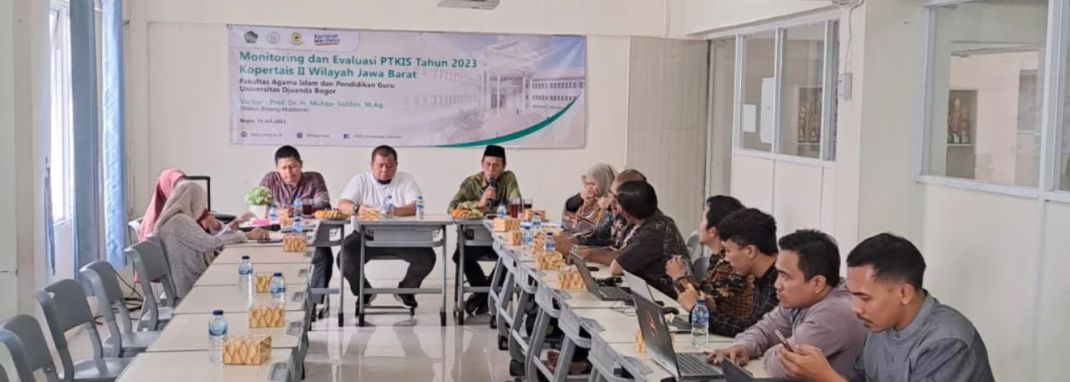
Universitas Djuanda (UNIDA) received a visit from the Monitoring and Evaluation Team (Monev) of the Coordinator of Private Islamic Universities (KOPERTAIS) Region II for the Islamic Management Education Study Program (MPI), Arabic Language Education (PBA), Sharia Banking (PBS), and Sharia Economics at the Faculty of Islamic Religion and Teacher Education (FAIPG), on Saturday (15/07/2023).
The visit of the Monev KOPERTAIS Region II Team was led directly by the Deputy Coordinator for Academic Affairs Prof. Dr. H. Muhtar Solihin, M.Ag who was welcomed by UNIDA Vice Rector I Aal Lukmanul Hakim, S.H., M.H, along with the Vice Dean and Head of Study Programs within FAIPG who were visited.
UNIDA Vice Rector I Aal Lukmanul Hakim, S.H., M.H welcomed this activity. This is because the implementation of this Monev is important to review and evaluate the implementation of higher education tri dharma activities, especially related to performance achievements for the progress of the MPI, PBA, PBS, and ESY Study Programs.
"Hopefully, the four study programs under KOPERTAIS will be better in the future. Please for that, the Study Program team prepares the data and things needed and records the things conveyed by Prof. Dr. H. Muhtar Solihin, M.Ag," said Aal Lukmanul Hakim, S.H., M.H. when giving a speech.
Meanwhile, Deputy Coordinator for Academic Affairs of KOPERTAIS Region II Prof. Dr. Muhtar Solihin, M.Ag said, now it has entered the digital era which is a must for a university to adapt and optimize digitalization opportunities. For this reason, this opportunity needs to be utilized as well as possible. Digital publication is one of the things that can be done to improve the branding image of universities.
"There are 4 things I want to convey, first how we try to make our management IT-based, following the industrial revolution where everything is digital. Many things can be recorded and published to develop Accreditation. Second, how do we make the Qur'an the basis of curriculum and the foundation of principles, so that the Qur'an becomes a brand of theory Third, human resources based on publications, journals, articles, and scientific papers become the gateway to a lecturer. Fourth, cooperation is based on internationalization. Those four things become brainstorming and upgrading how we develop the University," he explained.