
Last Updated: 2 weeks ago
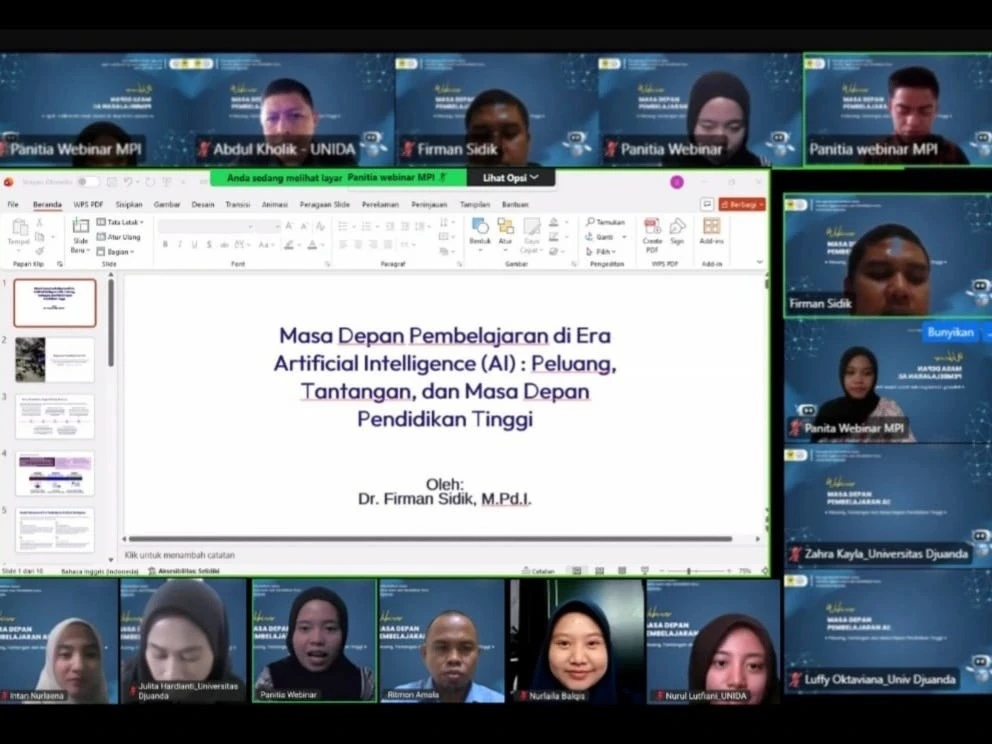
Bogor – The Management of Islamic Education Study Program (MPI), Faculty of Islamic Studies and Teacher Education (FAIPG), Djuanda University (UNIDA), organized a webinar titled "The Future of Learning in the Era of Artificial Intelligence (AI): Opportunities, Challenges, and the Future of Higher Education" on Wednesday, July 8, 2026, via Zoom Meeting. The webinar was conducted as part of the Fundamentals of Management course taught by Dr. Abdul Kholik, M.Pd.I. and also served as an implementation of the academic collaboration between the MPI Study Program of FAIPG UNIDA and the MPI Department of IAIN Sultan Amai Gorontalo.
The webinar was attended by 60 participants, including students from the Management of Islamic Education (MPI), Elementary School Teacher Education (PGSD), Arabic Language Education (PBA), and Law Study Programs at Djuanda University. The event also attracted participants from several higher education institutions, including IAIN Sultan Amai Gorontalo, STAI Al-Hidayah Bogor, Institut Madani Nusantara, and Universitas Terbuka, fostering broader academic collaboration and the exchange of knowledge across institutions.
The webinar featured Dr. Firman Sidik, M.Pd.I., Head of the Department of Management of Islamic Education at IAIN Sultan Amai Gorontalo, as the keynote speaker. In addition, Ritmon Amala, M.Si., Secretary of the Department of Management of Islamic Education at IAIN Sultan Amai Gorontalo, led a hands-on session on utilizing Claude AI as a tool to support academic writing.
During his presentation, Dr. Firman Sidik explained that the rapid advancement of Artificial Intelligence has significantly transformed learning systems in higher education. He emphasized that universities need to adapt their teaching strategies to the characteristics of each generation, from the Baby Boomer generation to Generation Alpha, in order to remain relevant to technological developments and future educational needs.
He further noted that Artificial Intelligence offers numerous opportunities to enhance the quality of learning. The technology can assist lecturers in developing more adaptive learning materials, support personalized learning experiences, accelerate the feedback process, and help students access academic references more efficiently.
In addition to highlighting its potential, the speaker also discussed several challenges related to the implementation of Artificial Intelligence in Indonesia, including uneven digital literacy, limited technological infrastructure, and the need to strengthen the digital competencies of both lecturers and students. He stressed that these challenges must be addressed to ensure that digital transformation in higher education can be implemented effectively.
During the practical session, Ritmon Amala introduced participants to the use of Claude AI in academic activities. Participants learned how to use the platform to develop writing outlines, improve sentence structure, select more appropriate vocabulary, and edit academic manuscripts to make them more systematic and easier to understand.
Through this webinar, participants not only gained a deeper understanding of the opportunities and challenges of Artificial Intelligence in higher education but also acquired practical experience in using the technology responsibly and ethically. The activity is expected to strengthen students' digital literacy while encouraging the development of innovative, adaptive, and high-quality learning in the era of digital transformation.