
Last Updated: 1 week ago
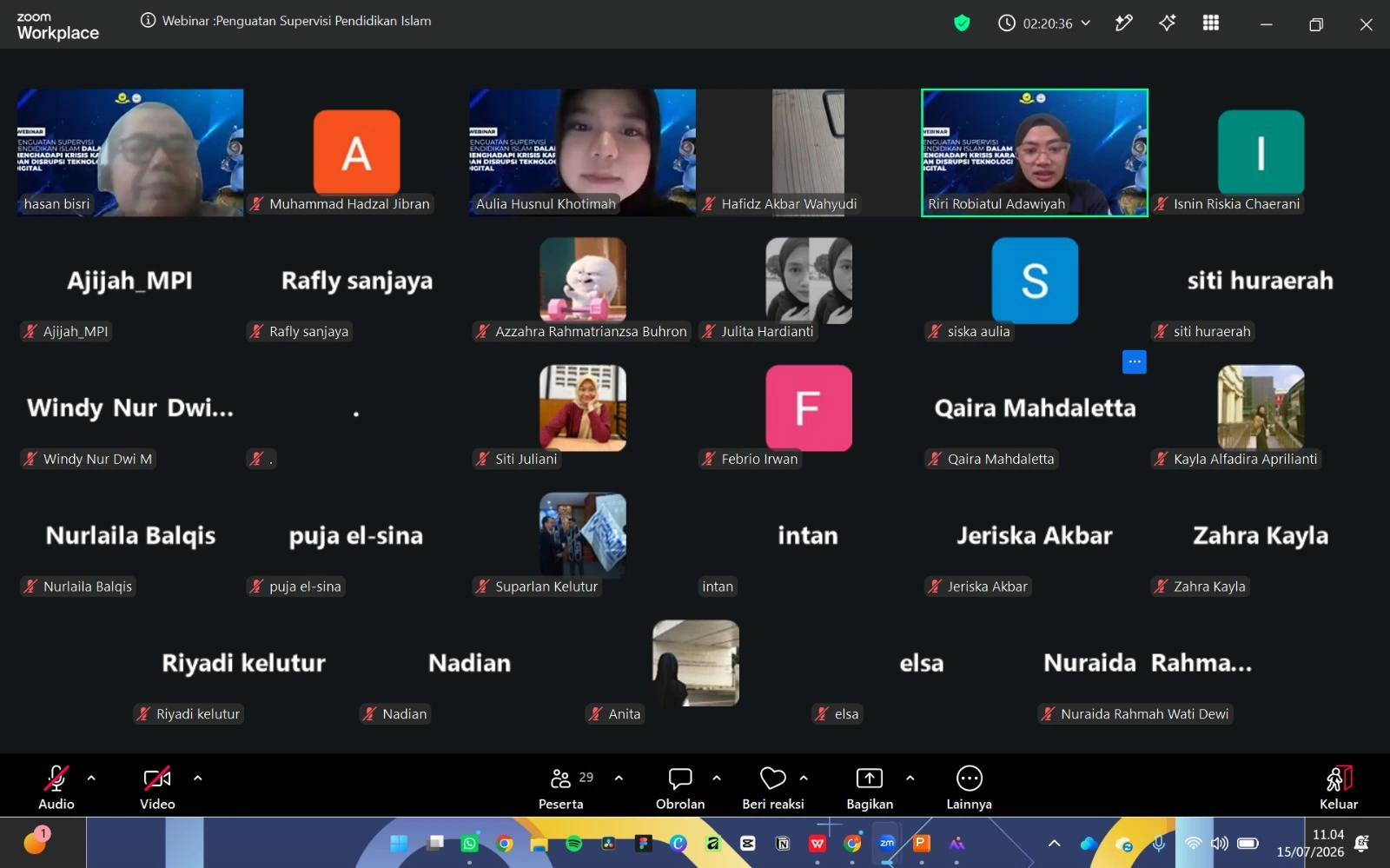
Students of the Islamic Education Management Study Program at Djuanda University successfully held a national webinar on Wednesday, July 15, 2026, via Zoom Meeting.
Carrying the theme "Strengthening Islamic Educational Supervision in Addressing the Character Crisis and Educational Disruption," the webinar was organized to educate participants while promoting the wise integration of artificial intelligence (AI) and technology in education. Its objective was to ensure that technology is utilized appropriately to enhance the quality of education in the era of disruption. The webinar was attended by 38 participants from various backgrounds, including university students, school students, and educational staff.
The participants remained highly engaged throughout the webinar, particularly during the discussion session. Many raised practical concerns regarding the use of technology in today's disruptive educational landscape.
In his opening remarks, Abdul Kholik, Dean of the Faculty of Islamic Studies and Teacher Education as well as the lecturer for the Fundamentals of Management course, explained the purpose of the webinar. He stated that the event was intended to provide students with practical experience in organizing academic activities.
"This final assignment, which takes the form of a webinar, is designed to help students develop the ability to plan, organize, implement, and evaluate an activity. The selected theme must also reflect current educational issues in order to deepen students' knowledge as future educators who will face the diverse challenges within the field of education," he said.
During the presentation session, the webinar speaker, Hasan Bisri, explained that educational supervision plays a comprehensive role in ensuring that character values are maintained in the use of technology.
"The use of technology in student learning must be accompanied by supervision from teachers so that it is utilized in accordance with its intended purpose," he stated.
The Chair of the Organizing Committee, Hadzal Jibran, also shared his expectations regarding the follow-up after the webinar.
"The follow-up plan is still under discussion. In the future, we hope to organize specialized training sessions so that participants can explore this topic in greater depth and with more specific guidance," he said.
One of the webinar participants, Isnin Riskia, also expressed her expectations regarding the event.
"I joined this webinar because I wanted to understand how Islamic educational supervision can adapt to the development of digital technology while continuing to preserve students' character development amid today's various challenges. I hope the knowledge shared in this webinar can be effectively implemented and prepare us to face real-life case studies," she said.
The webinar concluded with the presentation of a certificate and a token of appreciation to the speaker as an expression of gratitude from the organizing committee for the valuable knowledge shared.