
Last Updated: 5 months ago
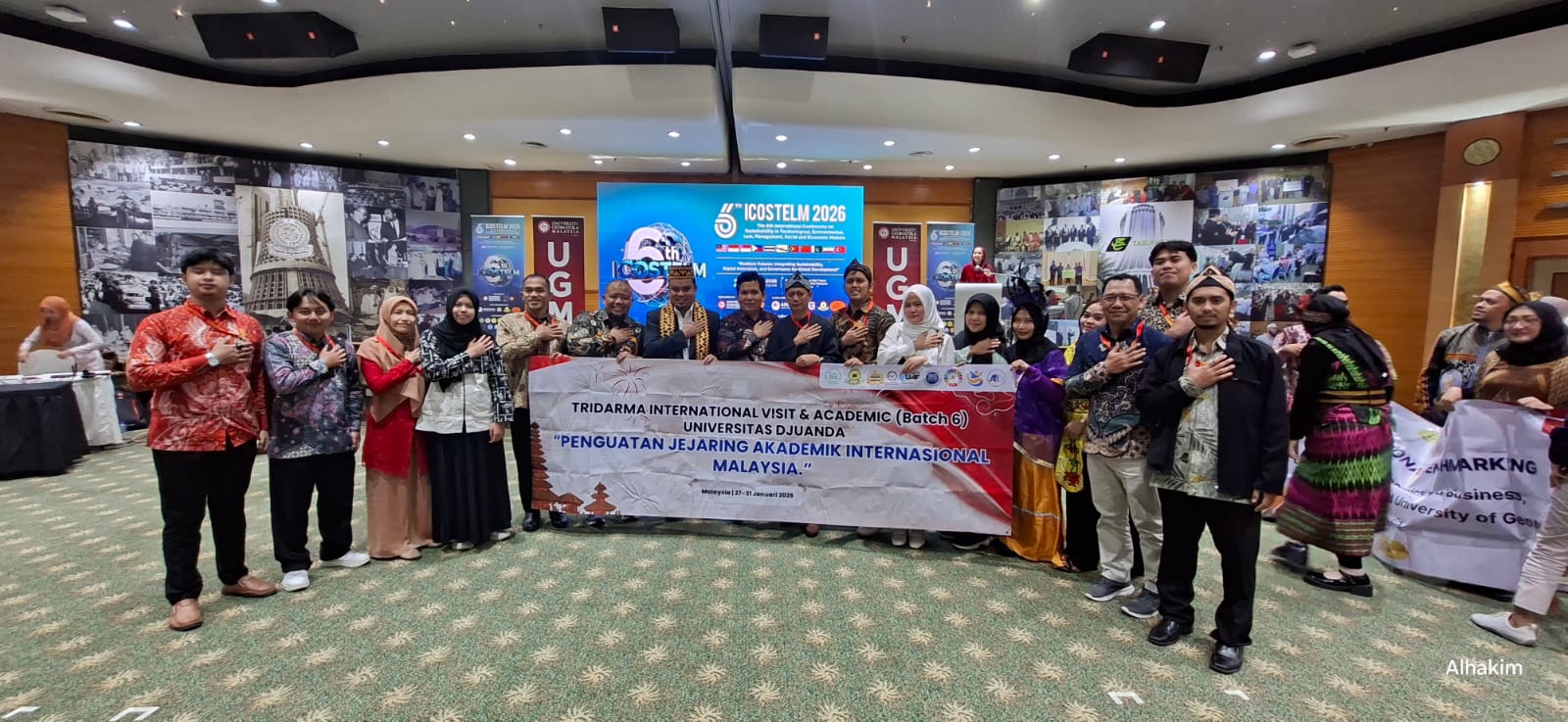
KUALA LUMPUR, January 29, 2026 – Lecturers from the Faculty of Islamic Studies and Teacher Education, Universitas Djuanda (FAIPG UNIDA), continue to strengthen their internationalization efforts on the third day of the Tridarma International Visit & Academic (Batch 6). On Thursday (29/1), the FAIPG UNIDA delegation actively participated in the prestigious The 6th International Conference on Sustainability in Technological, Environment, Digital Innovation, and Governance for Global Development (ICOSTELM 2026), held at the Grand Hall, Tabung Haji Tower & Universiti Geomatika Malaysia, Kuala Lumpur.
This activity became a strategic momentum for FAIPG UNIDA to strengthen its global role through research contributions relevant to Smart Environment issues and the achievement of the Sustainable Development Goals (SDGs).
The FAIPG UNIDA delegation at this international conference consisted of four lecturers from different study programs who presented leading research findings in accordance with their respective fields of expertise.
The first delegate, Dr. Helmia Tasti Adri, M.Pd from the Elementary School Teacher Education (PGSD) Study Program, presented a study entitled “Scientific Reasoning of Elementary Students with Mild Disabilities through UDL-Oriented Gamification.” This research highlights the importance of the Universal Design for Learning (UDL) approach combined with gamification to improve scientific reasoning skills among elementary school students, particularly those with mild special needs. This study contributes to strengthening sustainable inclusive education, in line with the SDGs in the field of quality education.
The second delegate, Muhammad Amin, S.HI., M.Si from the Islamic Economics Study Program, presented a paper entitled “Ready-Mix Raw Material Management System to Increase Production Capacity and Develop Byusel Chips MSMEs.” This research explores innovations in ready-mix raw material management systems as a strategy to increase production capacity and support the development of Byusel chips MSMEs. The study emphasizes the role of production management technology in promoting sustainable economic growth and empowering MSMEs.
The third delegate, Maya Apriyana, M.E from the Islamic Banking Study Program, presented research entitled “Productive Waqf as an Instrument of Islamic Economics to Achieve Sustainable Community Welfare.” This study underscores the potential of productive waqf as an Islamic economic instrument capable of promoting sustainable community welfare. Waqf is viewed not only as a form of social worship but also as a strategic source of social financing to support community economic development and the achievement of the SDGs.
The fourth delegate, Muhammad Kafnun Kafi, M.Pd from the Islamic Education Study Program, presented a study entitled “Gender Equality in Islamic Education: From Tradition to Global Demands.” This research emphasizes that Islamic education is required to reaffirm the values of justice, equality, and equal access to education for all genders without abandoning sharia principles. Essentially, Islamic education must move from traditionally biased understandings toward an inclusive, fair, and globally relevant educational system.
FAIPG UNIDA’s participation in The 6th ICOSTELM 2026 serves as tangible evidence of the implementation of the Tridarma of Higher Education, particularly in the areas of research and community engagement based on international collaboration. This participation not only expands global academic networks but also strengthens FAIPG UNIDA’s position as a faculty actively contributing to international scholarly discourse on Smart Environment and the SDGs.
Through this forum, FAIPG UNIDA hopes to continue encouraging the development of innovative research with tangible impacts on society, while further enhancing the global reputation of Universitas Djuanda.