
Last Updated: 2 years ago
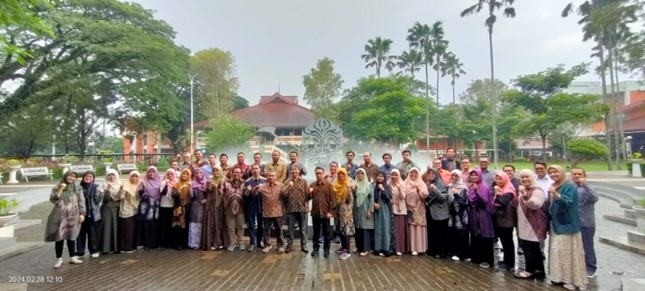
The Sharia Economics Study Program of the Faculty of Islamic Religion and Teacher Education attended a workshop event initiated by APSEII (Association of Indonesian Islamic Economics Study Programs) entitled "Building an Islamic Economics-Based CurriculumOutcome Based Education (OBE)” which will be held on Wednesday 28 February 2024 at the University of Indonesia.
This activity is divided into 2 sessions. The first session was moderated by Clarashinta Canggih, S.E., CIFP with the theme "Review of the Islamic Economics Curriculum in Preparing Superior and Competitive Human Resources". The speakers in the first session were Mr. Ferry Syarifuddin as Senior Deputy Director of Bank Indonesia, Mr. Mohamad Soleh Nurzaman as Deputy Director of KNEKS Sharia Economic Infrastructure, Mr. Asadulloh Sefnado as Head of the OJK Sharia Financial Literacy and Inclusion Group and Mr. Bambang Sutrisno as representativeGroup Head BSI Corporate University.
Ferry Syarifuddin as Deputy Senior Director of Bank Indonesia explained that "there are three supporting policy pillars for the position of sharia economics in Bank Indonesia, including pillar 1, sharia economic empowerment through development halal value chain supported by pillar 2 of sharia financial market deepening to encourage sharia financing both through sharia commercial and social finance and through the integrity of both. "The development of pillars 1 and 2 is supported by pillar 3, namely strengthening research and education to increase literacy through education and socialization of sharia economics."
This is in line with the opinion expressed by Mohamad Soleh Nurzaman who stated that "education is not only centered on the material that must be completed, but also outcome (knowledge and measurable skills) so that the development of the OBE curriculum must be designed by the needs of graduates when working which the learning process helps students achieve outcome which has been determined through RPS and based on level output which has been determined"

Meanwhile, the second session of the event was hosted by Dr. Aas Nurasyiah, M.Si. with the theme title "Redesign of the OBE-based Islamic Economics Curriculum'' which was presented by Mr. Cupian, SE., MT., Ph.D as Chair of APSEII and Dr. Abdul Qoyum, SEI., M.Sc.Fin. Based on the results of the presentation relating to the OBE curriculum and the agreement of APSEII members, it was agreed that the first was related to the profile of graduates including Islamic economics analysts, practitioners and entrepreneurs or entrepreneurs, secondly the maximum CPL (Graduate Learning Outcomes) was 13 CPLs and the last was related to additional courses is technology and digitalization as an additional course.