
Last Updated: 11 months ago
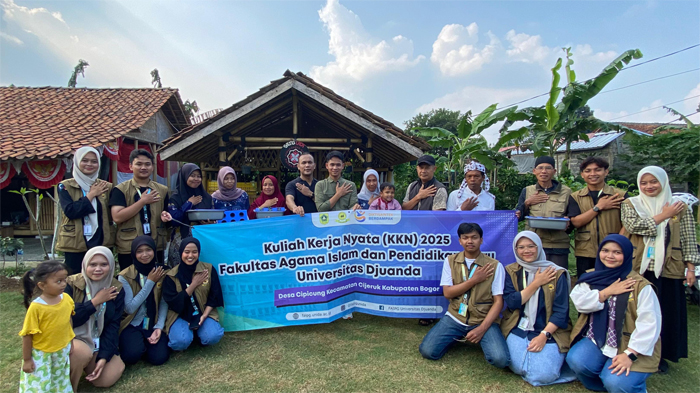
Students of the Community Service Program (KKN) of the Faculty of Islamic Studies and Teacher Education (FAIPG) of Djuanda University (UNIDA) Group 3 of Cipicung Village held a Floating Raft Hydroponic Socialization with the theme Smart Solutions for Farming on Narrow Land (08/16/2025)
Increasing population growth has led to a growing demand for food. However, the availability of agricultural land is decreasing due to land conversion for residential, industrial, and infrastructure purposes. This situation demands agricultural innovations that can address the challenges of limited land while producing healthy, high-quality food products. One potential solution is the floating raft hydroponic system. This method does not require soil, but instead utilizes nutrient-rich water as a growing medium. Furthermore, floating raft hydroponics offers several advantages, including efficient land use, environmental friendliness, ease of application in urban environments, and relatively fast harvests. Therefore, this method is ideal as a smart solution for farming on limited land.. Through this outreach activity, the community is expected to gain knowledge, skills, and motivation to utilize limited land, even home gardens, for modern farming. The application of floating raft hydroponics can also be a promising business opportunity to support food security for families and the surrounding community.
The purpose of this floating raft hydroponic outreach program is to provide the public with an understanding of the basic concept of soil-free farming using nutrient-rich water as a growing medium. This activity is expected to raise public awareness of the importance of agricultural innovation as a solution to land constraints, particularly in urban areas. The outreach also aims to introduce practical techniques for implementing floating raft hydroponics, which are easy to apply to limited land, thereby promoting family food self-sufficiency. Furthermore, this activity is expected to open up new hydroponic-based business opportunities that have economic value and support community welfare improvements.
Fitrah Sulifah, in her remarks, expressed her deepest gratitude to the ladies and gentlemen and all the community members who welcomed her very well.
"First of all, allow me, on behalf of my friends in the Community Service Program (KKN), to express my deepest gratitude to all the members of the community who have welcomed us so warmly. This KKN activity is part of our dedication as students to contribute to community development, particularly in the fields of education, social work, and community empowerment. On this occasion, we are raising the theme"Smart Solutions for Farming on Small Land""Through the socialization of floating raft hydroponics. We chose this theme because we see that limited land is often a barrier to farming. With the floating raft hydroponic method, people can utilize limited space, even their yards, to grow vegetables healthily, efficiently, and productively," he said.
Muhammad Ridho S.P, in his presentation of the material, said that hydroponics, especially the floating raft system, is a way of growing plants without using soil.
"Hydroponics, specifically the floating raft system, is a method of growing plants without using soil. The primary medium is nutrient-rich water, while the plants are placed on Styrofoam or floating containers so the roots directly absorb the nutrients. The advantage is that we can grow fresh vegetables even in a small yard, on a terrace, or even on a rooftop. Dear Sirs and Madams,"If we wait until we have a large plot of land to start farming, we might never get started. But with hydroponics, even a small patch of yard can become a source of healthy food.""This means never underestimate the limited space we have, because with creativity, a small plot can yield great benefits. In this presentation, I will explain several things. First, the basic concept of floating raft hydroponics and how it works. Second, what simple materials and equipment we can use, from used plastic cups, Styrofoam, to water buckets. Third, the benefits that can be obtained from farming with this system, both for family consumption, increasing daily nutrition, and as a small business opportunity with economic value," he said.
Arnold Waderma Purba, S.P., M.M., continued in his presentation, explaining that floating raft hydroponics isn't complicated. In fact, we can implement this method using simple materials found around us.
“POn this occasion, I will focus more on explaining the practical technical application of floating raft hydroponics so that you and your friends are better prepared if you want to start it at home. Dear Sirs and Madams, Floating raft hydroponics is not complicated. In fact, we can implement this method using simple materials found around us. I often say,"Where there's a will, there's always a way. Even with used containers, buckets, or plastic cups, we can start hydroponics."So, don't wait until you have a lot of capital to try, because the most important thing is intention and consistency. In this session, I will explain several important things. First, prepare materials and tools.,"I'll cover all the necessary materials, such as water containers, Styrofoam, net pots, and plant nutrients. Second, the planting stages, from sowing seeds and transferring seedlings to a floating raft system to daily care. Third, maintenance tips, including how to manage nutrients, maintain water quality, and manage potential pests or diseases. And finally, I'll share my experience on how hydroponics can develop into a promising small business opportunity if pursued seriously," he said.
Through this activity, we hope that the community will not only gain new knowledge from this floating raft hydroponic socialization, but also be able to apply it effectively in their surrounding environment. We want participants to have practical skills in utilizing limited land to be more productive, while also being motivated to try farming using simple yet modern methods. We hope that floating raft hydroponics can be a real solution to support family food security and can even develop into a small business opportunity with economic value. Furthermore, we hope this activity will foster a shared awareness that limited land is not an obstacle to farming, but rather a challenge that we can address with innovation. We hope that the knowledge we share will be a valuable asset for the community and provide long-term benefits, both for food independence and shared prosperity.